Who we serve · Hormone & Wellness Clinics
SEO for Hormone & Wellness Clinics.
We build organic search visibility for hormone optimization clinics, TRT practices, anti-aging medicine, functional medicine, longevity clinics, and med spas — across every surface a prospective patient touches before they book. One practice, one strategy — your complete search visibility system, in sync.
Starting at $5,000/month · Calendly-first booking · Founder reviews every inquiry personally.
Patients searching every month — hormone category
~23,270
across HRT, BHRT, pellet therapy, "hormone clinic near me," and close variants — that's your market looking for a clinic right now
HRT market by 2036
$33.7B
up from ~$22B in 2024 — the patients are coming; the clinics they find first win them
Typical first Map Pack wins
30–90 days
on a well-optimized Google Business Profile — the fastest-moving surface in the system
Why we built this practice
Generalist agencies treat a hormone clinic like a general dentist. It costs you patients.
Most "local SEO" agencies run the same playbook on a hormone clinic that they'd run on a plumber. Pull the client's Google Business Profile, tag a generic "Medical Clinic" category, build a handful of citations, write a blog post a quarter, call it optimization. A general-practice business can survive that. A hormone clinic can't.
Hormone, TRT, and anti-aging practices compete in a vertical where Google treats every piece of content as YMYL (Your Money or Your Life) — scrutinized for E-E-A-T signals, downranked if the authorship isn't clear, de-indexed if claims cross the FTC or FDA line. On top of that, patients in this market research for weeks before they book. They read the treatment page, check Healthgrades, scroll through reviews, ask ChatGPT, compare your clinic to the one in the next ZIP, and only then call. If any one of those surfaces is broken, weak, or invisible, you lose them to the clinic that showed up everywhere.
We rebuilt our local SEO practice around this. Not because hormone clinics are a trendy vertical, but because there's a real structural gap — the agencies pitching "med spa marketing" don't understand healthcare schema or FTC Section 5 substantiation, and the healthcare marketing agencies don't understand the Map Pack or Local Service Ads. We run all of it — one coordinated footprint.
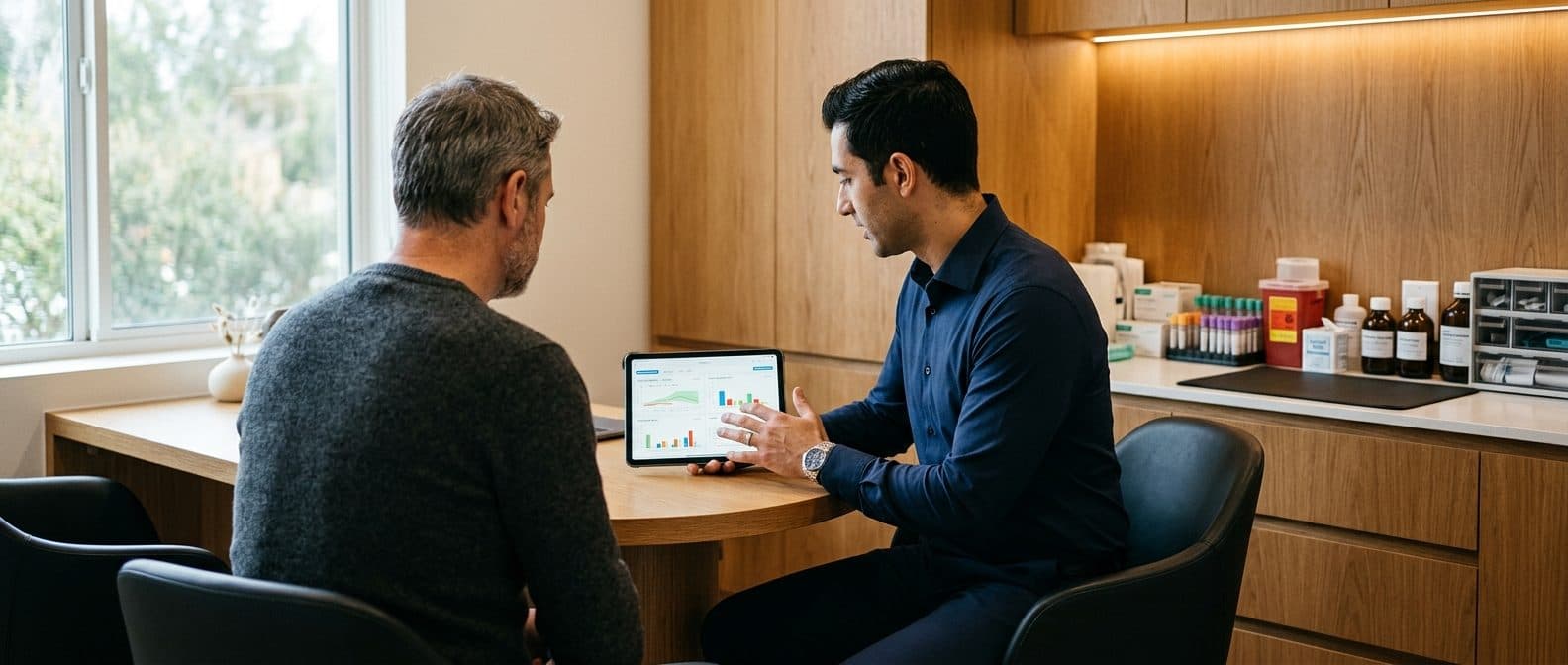
One practice, one strategy — every surface a patient touches, in sync.
— The Holistic system
What we do
The complete visibility playbook, applied to a hormone clinic.
Every patient search touches a handful of surfaces before a booking — Google, Maps, ads, social, and AI answers. Our job is to make your clinic visible on all of them — not as separate campaigns, but as one coordinated footprint where each surface reinforces the others.
//01
Local Pack + Google Business Profile
Correct GBP categories for your specific clinic (Hormone Therapy Clinic vs. Men's Health Clinic vs. Medical Spa, plus secondary categories that let you surface for peptide, TRT, and IV searches). Weekly posts, service-menu attributes, photo strategy, and matching MedicalClinic schema on the site.
//02
Local Service Ads + Google Screened
Google Screened (not Guaranteed — only non-medical verticals get Guaranteed) for your licensed providers, bid management tuned to cost-per-consultation, weekly dispute filing for off-scope leads, lead-quality scoring against your patient-fit criteria.
//03
Organic search + YMYL content
Treatment pages (TRT, BHRT, peptides, semaglutide, IV therapy) + condition pages (low T, perimenopause, adrenal fatigue) + city pages, all with medically reviewed copy, provider bylines, and structured data. Built for the actual long-tail queries your patients run, not keywords.
//04
AI / GEO (how LLMs cite you)
How ChatGPT, Perplexity, Gemini, and Google's AI Overviews describe your clinic when someone asks "best hormone clinic in [city]" or "is TRT worth it." Citation building, Wikidata entity, review volume on the directories LLMs crawl (Healthgrades, RealSelf, Vitals).
//05
Paid social — Meta Ads
Facebook + Instagram campaigns inside Meta's Special Ad Category for housing/credit/health. HIPAA-safe audience building (no patient lists into Meta), compliant creative that survives review, landing pages that convert. Paired with every SEO engagement, or sold standalone.
//06
Reviews, citations, authority
HIPAA-conscious review automation (no PHI in drafts), citation cleanup across the medical directory stack, editorial link building from men's health, longevity, and wellness publications. The part of the work that compounds for years.
What makes hormone-clinic SEO different
Five things we know about this vertical that generalist agencies don't.
Every hormone, anti-aging, and functional medicine clinic we work with gets the same audit pattern: the previous agency (if there was one) usually did the easy work well — homepage keywords, a handful of service pages, GBP verified — and got every nuance wrong. The nuances are where the patients are.
Below are the five areas that separate an SEO program that actually fills consultations from one that hits rankings but leaks leads. Each one is a place where a generalist agency either shortcuts or doesn't realize there's work to do.
//01
YMYL content standards (E-E-A-T, medical review)
Every treatment and condition page needs clear authorship, credentials, reviewed-by-a-clinician workflow, and transparent disclaimers. We build this into the CMS so you can't publish without it. Sites that skip it got crushed by the medic update and every core update since.
//02
FTC substantiation for health claims
The FTC Act Section 5 requires competent and reliable scientific evidence for any health or performance claim in advertising or content. We flag risky language on every page — "reverses aging," "guaranteed results," "cures low T" — and rewrite to what's substantiable.
//03
FDA boundaries on therapy and compound marketing
Compounded testosterone, semaglutide, peptides, HCG, and similar have specific marketing restrictions — you cannot market a compounded drug as equivalent to an FDA-approved product. We know what can and can't appear on a treatment page, and we audit continuously as the landscape shifts.
//04
Google Screened for licensed healthcare (not Guaranteed)
Medical, legal, real estate, and financial verticals qualify for Google Screened in LSAs — provider-level license verification, not the business-level background check that Google Guaranteed uses. Most agencies get this wrong. We set it up right.
//05
HIPAA-safe review and retargeting workflows
You cannot upload a patient list to Meta's Custom Audience tool without a BAA and a process that respects HIPAA. You cannot use patient names in review replies without written consent. We build review and retargeting workflows that respect HIPAA from day one — because a $50k fine is worse than a slow month.
How an engagement runs
Discovery → Audit → Strategy → Build → Monitor.
A hormone clinic SEO engagement is not a one-month sprint. It's a 90-day foundation build followed by a compounding monthly rhythm. Here's what it looks like.
Step 01
Discovery call
30 minutes with Mike. We pull your GBP, your LSA account (if you have one), your top three competing clinics, and your current site — live, on the call. You leave knowing whether we're a fit and what a real program looks like.
Step 02
Complete visibility audit
2–3 weeks of agent-assisted + human-reviewed analysis: technical, content, GBP, citations, reviews, LSA, Meta, Healthgrades / RealSelf / Vitals, analytics. Output is a prioritized roadmap with owner, effort, impact.
Step 03
Strategy + 90-day plan
Which surfaces we hit first, what lands in month one, what's the compounding bet. A working session with your team to align on priorities and patient-fit definitions before any build ships.
Step 04
Build + content foundation
Treatment page rebuilds, condition pages, city pages, GBP optimization, citation cleanup, schema, review engine, LSA setup. Written by senior humans with a medical reviewer in the loop. Typical month-one output: 6–12 pages + GBP rebuild + LSA verified.
Step 05
Monitor + compound
Weekly agent-monitoring flagging anomalies + monthly senior review. Content refresh on a quarterly cadence. Review and link building continuous. This is where the program starts to pay for itself — and keeps paying, because organic and local SEO compound.
Founder-led — Mike works your market directly
What success looks like
The four metrics we actually track.
We don't report rankings as a headline number. Rankings are an input. What we optimize for — and what we report monthly — is whether your clinic's calendar is filling faster, cheaper, and with better-fit patients than it was last quarter.
M1
Booked new-patient consultations per month
The only outcome that matters. Tracked via CallRail + Calendly + GBP actions + Meta CAPI, attributed back to source.
M2
Cost per booked consultation, by surface
We split this across LSA, Meta, organic, and Map Pack so you can see which surfaces are carrying the program — and reallocate as the numbers change.
M3
Map Pack share-of-voice for primary + secondary queries
Your visibility in the 3-pack for "[treatment] near me" and the secondary terms patients actually use. Tracked daily, reviewed weekly.
M4
LLM citation rate
How often ChatGPT, Perplexity, and Google AI Overviews cite your clinic when someone asks about the treatments you offer. Early-stage metric, but it's where the next leg of patient acquisition is going.
Illustrative metrics. Individual clinic results vary by market, intake capacity, and baseline. No guaranteed outcomes — standard FTC endorsement disclaimers apply.
Choose your subtype
Every vertical has its own playbook. Pick yours.
The system is the same across hormone, TRT, anti-aging, functional medicine, longevity, med spas, and weight-loss clinics. The tactics inside it are not. Each subtype below gets its own page with the keywords, compliance rules, and content strategy specific to that vertical. New subtypes ship weekly through the Phase-2 rollout.
V1
SEO for TRT Clinics
For testosterone replacement therapy and men's health practices.
See page
V2
SEO for Anti-Aging Clinics
For age management and longevity medicine practices.
See page
V3
SEO for Functional Medicine
For functional, integrative, and regenerative medicine clinics.
See page
V4
SEO for Longevity Clinics
For longevity, peptide therapy, and IV therapy providers.
See page
V5
SEO for Med Spas
For multi-service med spas with aesthetics + wellness.
See page
V6
SEO for Weight Loss Clinics
For semaglutide, GLP-1, and medical weight loss practices.
See page
Common questions
Answered straight.
How long does SEO take for a hormone clinic?
Map Pack wins on a well-set-up GBP show inside 30–90 days. Material consultation-volume lift from organic usually lands in months 4–6. Full compounding — the point where organic is carrying a meaningful share of bookings and you're not dependent on paid spend — is a 9–18 month commitment. We plan in 90-day blocks and show you the measurable change at each gate.
Do you help with Google Business Profile for medical practices?
GBP optimization is the single highest-ROI move for most hormone clinics and it's table stakes in every engagement. That includes primary + secondary categories (Hormone Therapy Provider, Men's Health Clinic, Medical Spa, and secondary categories for peptide, TRT, IV where they apply), service menus mapped to your actual offerings, weekly posts, photo strategy, and the MedicalClinic schema on your site that backstops the profile.
Can hormone and TRT clinics run Google Ads or LSAs?
Yes — with specifics. Licensed healthcare providers qualify for Google Screened in LSAs (not Google Guaranteed, which is a non-medical product). Google Ads (Search + Display) works for most hormone therapy advertising with compliant creative, but compounded TRT and semaglutide ads hit more restrictions than FDA-approved equivalents. Meta Ads are a bigger part of the paid mix for this vertical precisely because of those restrictions — we run both.
What's the difference between Google Screened and Google Guaranteed?
Google Screened is for licensed professionals — medical, legal, financial, real estate — and verifies the individual provider's license and background. Google Guaranteed is for home-services businesses — plumbers, electricians, HVAC — and comes with a money-back guarantee from Google. Hormone clinics and med spas with a medical provider get Screened, not Guaranteed. Agencies that promise "Google Guaranteed for your TRT clinic" do not know what they're selling.
How do you handle YMYL content requirements?
Every treatment and condition page ships with: a named clinical author (the provider) or a clearly credentialed reviewer, a last-reviewed date, linked citations to peer-reviewed sources or regulatory guidance, structured data (MedicalWebPage, Physician, MedicalClinic where applicable), and a disclaimer structure that satisfies FTC substantiation rules. We set up the CMS so you can't publish without these fields populated.
What's your minimum engagement?
$5,000/mo, 90-day initial block, month-to-month after that. We don't run smaller engagements because the complete visibility system requires enough bandwidth to meaningfully work on every surface — and smaller retainers force the kind of shortcuts that get clinics in compliance trouble. If $5k/mo doesn't fit yet, consider an audit ($5k one-time) that gives you the roadmap and priority moves to execute in-house.
Works even better alongside
Pair this with the paid side of the system.
The paired page
Meta Ads for Hormone & Wellness Clinics
The paid-social side of the system. Facebook and Instagram ads that survive Meta's Special Ad Category review, respect HIPAA, and book consultations. Pairs directly with organic SEO.
Ready to see where your clinic is leaving patients on the table?
Book a 30-minute discovery call. We'll pull your clinic live across every surface and show you the three fastest wins — whether you hire us or not.